If you’ve ever wondered how to make croissants from scratch, this 100% Sourdough Croissant Recipe is the ultimate guide. These buttery, flaky pastries are made without commercial yeast — just a strong sourdough starter — and layered through the traditional lamination process to create those signature airy layers.
I spent years testing and refining this recipe until I finally achieved the perfect sourdough croissant: golden, crisp on the outside, and tender with honeycomb layers on the inside. In this post, I’ll share everything you need to know, from the ingredients you’ll need to detailed step-by-step instructions.
Because croissants are one of the most advanced sourdough bakes, this recipe includes all my best tips and techniques to help you succeed at home. With a little patience and practice, you can bake bakery-style sourdough croissants right in your own kitchen.

Why You’ll Love Sourdough Croissants
- Advanced Sourdough Bake – This is one of the more advanced recipes on my site because it uses the traditional lamination process with 100% sourdough. That said, it’s very achievable with clear steps and some patience. If you’re looking for a little more room for error, you might want to try my Sourdough Discard Croissants (coming soon) or my Classic Croissants for a Home Baker, which use a touch of instant yeast to make the process a bit more forgiving.
- Buttery & Flaky – Nothing beats a freshly made croissant, but if you’re after something simpler that still has that buttery, flaky sourdough texture, try my viral Sourdough Croissant Bread or Sourdough Panettone Bread. For an easier take on croissants, you might also enjoy my Sourdough Croissant Rolls or my Sourdough Crescent Rolls. But if you’re ready for the full challenge, these 100% sourdough croissants are bakery-quality (or better), and absolutely worth the effort.
- Versatile – I love these croissants just as they are, warm and freshly made. But they’re also one of those bakes that can be used in so many ways. Slice one open for a sandwich, pair with jam for breakfast, turn leftovers into the best Sourdough French Toast Casserole, or freeze a batch so you can have homemade croissants anytime. However you enjoy them, this recipe gives you all the flaky layers and buttery flavor you’d expect from a bakery.
Important Ingredients
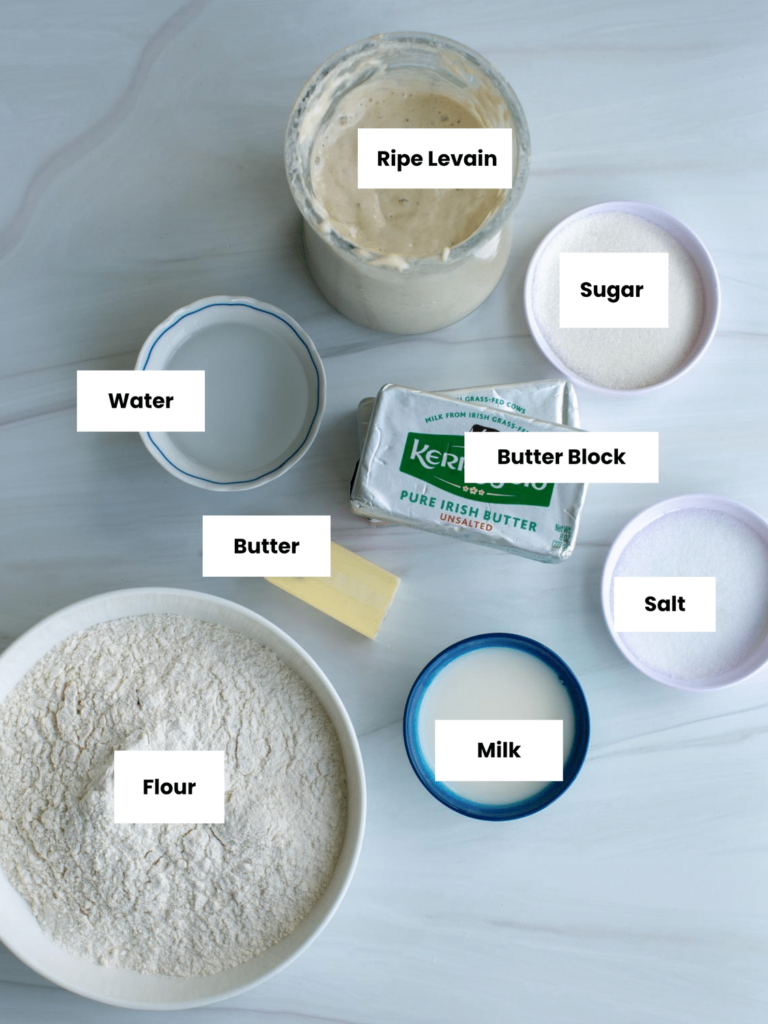
- Sourdough Starter – This recipe uses a levain that combines ripe and active sourdough starter, flour, and room temperature water, and is left to rise before using.
- High Quality Butter – Good butter is crucial in this recipe—it might even be the most important ingredient in these sourdough croissants! A good unsalted European-style butter with an 80% or higher butterfat is what you want. American butter has too much water in it and doesn’t make it a good candidate. Even though the butter is expensive, it’s worth it —if you are going to spend the time making this recipe, then you want to use quality ingredients to get it right. I used Kerry Gold unsalted butter with good results.
- Whole Milk – This dough uses whole milk for a richer flavor, softer crumb, better browning, and added tenderness.
- Bread Flour – This recipe uses bread flour with 11–13% protein for the best results. If you want to use all-purpose flour, I would decrease the water a bit to compensate.
Substitutions
Honestly, I would not make too many substitutions on this recipe. It’s been tested multiple times and through many failures, now it comes out so well! But here are a few if you want to try:
- Sourdough Starter: You can substitute active sourdough starter for the levain in this recipe.
- American-Style Butter: If you use American butter instead of European butter, you’ll need to add some flour to the butter block, like I do with my homemade croissant recipe.
- Unsalted Butter: I always prefer to bake with unsalted butter, but you can substitute salted instead.
- Fillings: This is where you can have fun: add chocolate, frangipane or other fillings to your croissant dough. Keep in mind that as a 100% sourdough recipe, this dough will be sitting out for many hours to proof, so you’ll want to make sure any fillings are safe to leave at room temperature for extended periods of time.
- Variations: You can use this dough to make a loaf — I do that with the scraps, and it’s delicious! You can also use this dough with any recipe that calls for laminated pastry dough, like the base for morning buns or twisted croissants.
Sourdough Baker’s Timeline
A sample baking schedule always helps me stay on track when baking with sourdough. Since sourdough rises much more slowly than commercial yeast bread, having a timeline in place makes planning easier.
A few notes before you start:
- The croissant dough can be refrigerated for up to a few days if you’d like to make it ahead of time, which gives you flexibility to fit the process into your schedule.
- This schedule assumes your dough is kept within specific temperature ranges during mixing, lamination, and proofing. Temperature management is critical — it will make or break your croissants.
| Day 1 | Evening |
| 8:00 PM – 8:00 AM (overnight) | Mix the levain. Let it ferment overnight until bubbly and active. |
| Day 2 | Morning & Afternoon |
| 8:00 AM – 8:20 AM | Mix the croissant dough |
| 8:20 AM – 2:30 PM | Let the dough rise at 78-80ºF |
| 8:30 AM | Prepare the butter block. |
| 2:30 PM | Shape the dough into a rectangle for chilling. |
| 2:30 – 6:30 PM | Chill the dough |
| Day 2 | Evening |
| 6:30 PM – 8:30 PM | Laminate the dough with butter |
| 8:30 PM | Roll out the laminated dough and shape into croissants |
| 8:45 PM – Overnight (8:45 AM) | Proof at 78-80ºF until doubled, jiggly, and airy |
| Day 3 | Morning |
| 9:00 AM | Egg wash and Bake sourdough croissants |
Sourdough Croissant Recipe
Buttery, flaky and made with 100% sourdough starter – no commercial yeast, these sourdough croissants are the perfect weekend bake. Use this step by step recipe so you can bake crisp, golden croissants straight out of your home oven!
Prep: 1 hour
Cook: 35 minutes
Fermentation, Lamination, Chill Time: 1 day 14 hours
Total: 1 day 15 hours 35 minutes
Servings: 16 croissants
Equipment
- stand mixer
- parchment paper
- rolling pin
- ruler
- 2 half sheet pans
- plastic wrap
- sharp knife
- thermometer optional
Ingredients
- 10 grams sourdough starter, ripe, bubbly and active
- ▢100 grams all purpose or bread flour
- ▢100 grams water
Sourdough Croissant Dough
- ▢200 grams levain, ripe, bubbly and active
- ▢120 grams water
- ▢120 grams whole milk
- ▢65 grams granulated sugar
- ▢55 grams unsalted butter, melted and slightly cooled
- ▢12 grams salt
- ▢550 grams bread flour
Butter Block
- ▢340 grams unsalted butter – European style 80% butterfat
Egg Wash
- ▢1 large egg
- ▢15 grams heavy cream, about 1 Tablespoon
- ▢pinch of salt
Instructions
Mix the Levain (1:10:10 about 10-12 hours)
- Mix 10 grams of ripe sourdough starter with 100 grams of water and 100 grams of flour. Cover and let sit overnight at 78ºF until doubled in size, bubbly, and active. You can also substitute 200 grams of bubbly sourdough starter if you prefer.
Sourdough Croissant Dough (10 hours minimum)
- Mix the Dough: To the bowl of a stand mixer fitted with a dough hook, add ripe levain, water, milk, granulated sugar, melted butter, salt, and bread flour. Knead on low to medium speed for about 8-10 minutes until you have a smooth, cohesive, and strong dough. The dough should feel tacky but not sticky; if it’s too sticky, add bread flour 1 Tablespoon (8-9 grams) at a time until it reaches the right consistency.If kneading by hand, work the dough for 12 to 15 minutes, until smooth and strong.
- First Rise (Bulk Fermentation): Place the dough in a clear container or glass bowl, cover with plastic wrap (or a shower cap) and let it rise in a warm spot until almost doubled in size, about 6 hours at (78–80ºF).
- Make the Butter Block: While the dough rises, prepare the butter block. For best results, use high-quality butter with at least 80% butterfat – see recipe notes. Tear off a 28-inch sheet of parchment paper and fold it using a ruler to create a 9×12-inch rectangle pocket (see photos in post).Slice the 340 grams of butter into six equal rectangular pieces and arrange them in a line inside the parchment. Fold the paper back over the butter and flip it over. Pound the butter a few times with a rolling pin, then roll from the center outward until the butter is pliable and evenly fills the 9×12-inch space. Chill the butter block for at least 2-3 hours or for a couple of days, until firm but still pliable (about 55–60ºF).
- Roll and Chill Dough: Once the dough has just about doubled in size, dump it out on the counter and roll it into a 12 by 18-inch rectangle. Place the dough on a half sheet (18 by 13 inch) baking sheet and pull the dough evenly to the corners of the baking sheet if needed. Cover with plastic wrap and refrigerate overnight (a minimum of 4 hours – the dough should reach 40-45ºF).
Laminate the Dough (2-4 hours)
- The lamination process will take a couple of hours to complete. Prepare your work surface and have extra flour, a ruler, a sharp knife, and plastic wrap ready. For the best results, the dough and butter should be about the same pliability before you begin. This happens when the dough is about 40–45ºF and the butter is 55–60ºF. At this temperature, the butter will be elastic and pliable without breaking. Once the butter is enclosed in the dough, aim to keep the dough around 55–60ºF while working to maintain even layers.
- Enclose the Butter in the Dough: Remove both the butter block and the dough from the refrigerator. Lightly flour your work surface and take the chilled dough out of the pan. Gently roll it into a 12×18-inch rectangle. The dough may shrink slightly after chilling, but it shouldn’t need much rolling since it was already shaped in the sheet pan. Check the measurements with a ruler.Unwrap the butter block from the parchment paper and confirm that the dough and butter are about the same pliability. The butter should feel elastic and not break into pieces, and the dough should be around 40–45ºF. If needed, lightly warm by moving it around with your hands until the textures match.Turn the parchment paper over to release the butter block onto the center of the dough—it should line up exactly with the dough’s width. Fold each side of the dough over the butter so the edges meet in the center, like folding a letter. Pinch the seams to completely seal the butter inside the dough.
- First Fold: Place the dough seam-side down with the 12-inch side vertical and the 6-inch side horizontal. Starting in the center, press gently with a rolling pin to make small indentations, moving upward and downward to help soften and spread the butter evenly inside the dough.At this point the dough is ready to be rolled into a 10 by 20-inch rectangle. Start in the middle of the dough and roll gently and evenly up to the top of the dough. Flip the dough 180 degrees, start in the middle and roll the dough gently and evenly. Flip the dough onto the other side and repeat the rolling, gently and evenly, starting in the middle and rolling up (then flipping the dough 180 degrees and doing it again) until the dough has reached about 20 inches long. Then rotate the dough 90 degrees so the 20 inch side is horizontal, start in the middle and roll up. Flip the dough 180 degrees and roll up again, continuing this process until the dough is rolled 10 by 20 inches.Next, begin rolling from the center outward. Roll gently up toward the top, flip the dough 180°, and roll again from the center upward. Flip the dough over and repeat this process, rolling from the center upward until the dough has reached about 20 inches long. Rotate the dough 90° so the long side is horizontal, then roll again from the center outward until the dough measures about 10 by 20 inches. Do your best to roll evenly and gently.Trim the edges with a sharp knife so they are neat and straight, then fold the dough in thirds, like folding a letter, to form a 10 by 6-inch rectangle. Wrap the dough in plastic wrap and chill in the refrigerator for about 1 hour, or place in the freezer for 20 minutes before the next fold.
- Second Fold: After the dough has chilled and rested to about 60ºF, remove it from the refrigerator or freezer. If it feels too cold and stiff, allow it to warm slightly so the butter is pliable again. Place the dough seam-side down with the 6-inch side horizontal and the 10-inch side vertical. As before, press gently in the center with the rolling pin to loosen the butter, then roll evenly from the center outward, flipping and rotating as needed, until the dough measures about 10 by 20 inches. Trim the edges neatly with a sharp knife, fold in thirds to form another 10 by 6-inch rectangle, then wrap well and chill for 1 hour in the refrigerator or 20 minutes in the freezer if using right away.Make Ahead Note: At this point, the dough can be refrigerated for up to 48 hours if you’d like to shape and bake your croissants on a different day.
Shape and Proof (10-12 hours)
- Roll and Shape: Roll the chilled dough into a 24 x 12-inch rectangle, about ¼–½ inch thick. Use the same gentle rolling technique as before: start in the middle and roll outward, working up toward the top, then flip the dough 180° and roll again from the center upward. Rotate as needed to keep the rectangle even, applying light, even pressure so you don’t crush the butter layers. Lightly dust with flour as you go if the dough begins to stick or looks like it’s going to split. Trim the edges neatly with a sharp knife to square off the dough.For smaller croissants, cut the dough into long triangles about 3 inches wide at the base and 12 inches long (yielding 16 croissants). For larger croissants, cut the triangles about 6 inches wide at the base and 12 inches long (yielding 8 croissants).To shape, gently stretch the base of each triangle, then roll it up from base to tip without pressing down, finishing with the tip tucked underneath. If needed, stretch the tip slightly as you finish rolling to create the classic croissant shape.Note (Chocolate Croissants): To make pains au chocolat, cut the laminated dough into rectangles about 3×6 inches. Place one or two chocolate batons (or a few pieces of dark chocolate) near one short edge, then fold the dough over the chocolate. Add a second baton and continue rolling until sealed. Place seam-side down on a parchment-lined baking sheet. You can also add a single baton of chocolate to a triangular croissant and roll it up as usual for a chocolate-filled variation.
- Proof: Cover the croissants lightly with plastic wrap and let them rise at about 78º-80ºF for 10–12 hours, or overnight, until doubled, puffy, and jiggly with visible layers. If your kitchen is cooler, place the trays in a slightly warm, humid environment, such as a turned-off oven, and set a cup of boiling or very hot water on the pan alongside them to create gentle warmth and steam. Be careful not to let the butter melt; the goal is a slow, steady rise.Note: Do not bake the croissants until they have properly risen. Because this is a 100% sourdough recipe, proofing takes longer than commercially yeasted croissants. If they haven’t nearly doubled in size after the overnight proof, give them more time. Baking under-proofed croissants will cause the butter to leak out in the oven instead of creating those flaky, airy layers.
Bake the Croissants (30-35 minutes)
- Bake: The croissants should be doubled in size, light, fluffy, and slightly jiggly when you shake the tray before baking. Preheat the oven to 375ºF (190ºC). In a small bowl, whisk together one egg with a splash of cream and a pinch of salt to make an egg wash.Gently brush the croissants, avoiding the cut edges so the layers stay open and don’t deflate. Bake for 30–35 minutes, rotating the pans halfway through, until the croissants are deeply golden brown and flaky. Transfer to a wire rack and let cool for at least 15 minutes before serving.
Notes
Cup Measurements: I usually provide recipes in both grams and cups, but croissants are one bake where precision really matters. Because this recipe is so technical, I’m only giving weight measurements. This ensures the best chance of success—especially for beginners. If you’re ready to tackle croissants, chances are you’ll want to use a scale anyway!
Butter: For the best croissant layers, use a European-style butter with at least 80% butterfat. It’s more pliable and has less water than most American butters, making lamination easier and flakier. I prefer using unsalted butter, but have tried this recipe with salted butter too and it works. If using American butter, try the flour-in-butter method from my Easy Homemade Croissants for more consistent results.
Laminating with a Machine: After laminating dough by hand too many times to count, I decided to invest in a compact dough sheeter. A dough sheeter makes the laminating process SO much easier with very even layers. The sheeter creates even layers and keeps lamination quick and consistent. For best results, chill the dough until firm but pliable, flour lightly to prevent sticking, and reduce the thickness gradually rather than all at once. Trim the edges to keep layers neat, let the dough rest between folds, and roll to about 4 mm for croissants.
Nutrition
Calories: 364kcal, Carbohydrates: 37g, Protein: 6g, Fat: 22g, Saturated Fat: 13g, Polyunsaturated Fat: 1g, Monounsaturated Fat: 5g, Trans Fat: 1g, Cholesterol: 67mg, Sodium: 303mg, Potassium: 64mg, Fiber: 1g, Sugar: 5g, Vitamin A: 660IU, Vitamin C: 0.01mg, Calcium: 24mg, Iron: 1mg