
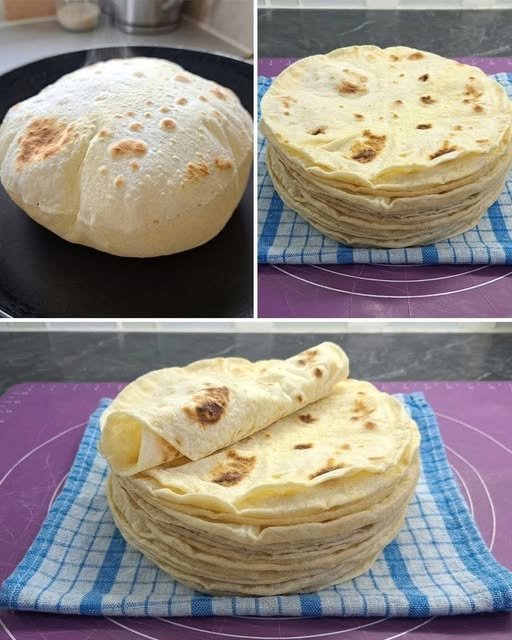
There is something incredibly satisfying about making a fresh stack of flatbreads at home. These soft homemade flour tortillas are tender, flexible, lightly golden, and perfect for wrapping around your favorite fillings. The photos show exactly what makes this recipe so special: beautifully puffed dough while cooking, a tall stack of thin flatbreads, and a freshly cooked tortilla rolled up while still warm.
Unlike many breads, these tortillas do not require an oven. Everything happens on a hot skillet or griddle, making them an excellent everyday recipe. With only a few basic ingredients and a little practice, you can make soft flatbreads that are much fresher and more delicious than packaged versions.
Whether you call them flour tortillas, homemade wraps, soft flatbread, or roti-style flatbread, this recipe is versatile enough for breakfast, lunch, dinner, and snacks.
Why You’ll Love This Recipe
The best homemade tortillas should be soft enough to fold without cracking. The secret is creating a smooth dough, allowing it to rest properly, and cooking each piece quickly on a sufficiently hot skillet.
Resting is especially important. It gives the flour time to absorb the water and allows the gluten to relax. This makes the dough easier to roll and helps prevent the tortillas from shrinking back into smaller circles.
A little oil or melted butter also helps create a tender texture. You can make them completely plain, or brush the finished tortillas with butter for extra richness.
Ingredients
For approximately 10 to 12 medium tortillas, you will need:
- 3 cups (375 g) all-purpose flour
- 1 teaspoon salt
- 1 teaspoon baking powder
- 3 tablespoons vegetable oil or melted butter
- 1 to 1¼ cups warm water
- Extra flour for rolling
- Optional: melted butter for brushing
The exact amount of water can vary depending on the flour. Start with less and gradually add more until the dough becomes soft and smooth.
Step 1: Combine the Dry Ingredients
Add the flour, salt, and baking powder to a large mixing bowl.
Whisk or stir everything together so the salt and baking powder are evenly distributed throughout the flour.
Baking powder is optional in some traditional flatbread recipes, but a small amount can help produce softer, lighter tortillas and encourage them to puff during cooking.
Step 2: Add the Oil
Pour the vegetable oil or melted butter into the flour mixture.
Use your fingers to rub the fat into the flour until the mixture feels slightly crumbly and evenly coated.
This step helps create a tender texture. The fat coats some of the flour particles and reduces excessive gluten development, resulting in flatbreads that are soft rather than tough.
If you prefer a richer flavor, melted butter works beautifully. For a more neutral tortilla that can be used with any filling, vegetable oil is an excellent choice.
Step 3: Add Warm Water
Begin adding warm water gradually while mixing with your hand or a wooden spoon.
Do not pour all the water in at once. Add a little, mix, and continue until the dough comes together.
The finished dough should be soft and pliable. It should not be extremely sticky, but it should feel noticeably softer than a typical bread dough.
If the dough feels dry or cracks when pressed, add another tablespoon of water. If it becomes too sticky, sprinkle in a small amount of flour.
Step 4: Knead the Dough
Transfer the dough to a lightly floured surface and knead it for approximately 5 to 8 minutes.
You are looking for a smooth, elastic dough.
Press the dough forward with the heel of your hand, fold it back toward you, rotate it slightly, and repeat.
You do not need to knead aggressively. Once the dough feels smooth and springs back gently when pressed, it is ready to rest.
Shape it into a ball and place it back in the bowl.
Step 5: Let the Dough Rest
Cover the dough with a clean kitchen towel or plastic wrap and let it rest for approximately 30 to 60 minutes.
Do not skip this step.
Resting allows the gluten to relax, making the dough much easier to roll. If you try to roll the dough immediately after kneading, it may keep shrinking back and become difficult to shape.
A longer rest can also make the dough especially soft and easy to work with.
Step 6: Divide and Shape
After resting, divide the dough into 10 to 12 equal portions.
Roll each piece between your palms to create a smooth ball.
Place the dough balls on a lightly floured plate or tray and cover them so they do not dry out.
If you want perfectly even tortillas, a kitchen scale can be useful for dividing the dough into equal portions.
Step 7: Roll the Tortillas
Take one dough ball and flatten it gently with your fingers.
Lightly flour your work surface and rolling pin. Roll the dough into a thin, round circle.
Try to roll from the center outward, rotating the dough frequently as you work.
The tortillas should be thin but not paper-thin. Aim for an even thickness across the entire circle. Uneven dough can cause some areas to cook too quickly while others remain undercooked.
Do not worry if your first few tortillas are not perfectly round. Homemade flatbreads often have charmingly irregular shapes, and they will taste just as delicious.
Keep the remaining dough balls covered while you work.
Step 8: Cook on a Hot Skillet
Heat a dry cast-iron skillet, heavy frying pan, or flat griddle over medium-high heat.
The pan should be properly hot before you begin cooking.
Place one rolled tortilla onto the hot surface.
After approximately 20 to 40 seconds, you should begin seeing small bubbles appear. Flip the tortilla and cook the second side.
You will notice golden-brown spots developing across the surface. Flip it again if necessary and cook until the tortilla is fully cooked but still soft.
The entire process should be relatively quick.
Avoid cooking the tortillas for too long. Overcooking removes moisture and can make them dry, brittle, and difficult to fold.
The Secret to Beautiful Puffing
One of the most satisfying moments is watching a tortilla puff up during cooking.
For the best chance of getting that beautiful balloon-like effect shown in the photo, make sure the dough is evenly rolled and the skillet is hot enough.
When the tortilla is placed on the hot surface, steam forms inside the dough. If the layers are properly sealed and the temperature is right, that steam can cause the tortilla to inflate.
Even if every tortilla does not puff dramatically, it can still be soft and delicious.
Keep the Tortillas Soft
As soon as each tortilla comes off the skillet, place it inside a clean kitchen towel or covered container.
The trapped steam helps keep the tortillas soft and flexible.
You can also lightly brush each hot tortilla with melted butter before stacking it.
Continue cooking and stacking the tortillas until all the dough has been used.
The result should be a beautiful pile of warm, flexible flatbreads, just like the stack shown in the photo.
Serving Ideas
These homemade tortillas can be used in countless ways.
For breakfast, fill them with scrambled eggs, cheese, potatoes, and vegetables. For lunch, use them as wraps filled with grilled chicken, salad, beans, or roasted vegetables.
They are also excellent for tacos, quesadillas, burritos, fajitas, and simple cheese wraps.
For something sweet, spread a warm tortilla with butter and honey, sprinkle it with cinnamon sugar, or fill it with sliced bananas and a little chocolate.
You can even cut leftover tortillas into triangles and toast or fry them to make homemade chips.
Storage
Fresh tortillas are best served warm, but they can easily be stored.
Allow them to cool completely and place them in an airtight container or resealable bag. Keep them at room temperature for a day or two.
For longer storage, separate the tortillas with parchment paper and freeze them in a freezer-safe bag.
When needed, reheat them briefly in a hot skillet or microwave. A few seconds of gentle reheating is usually enough to restore their softness.
Common Mistakes to Avoid
Using too much flour while rolling: Excess flour can make the finished tortillas dry. Use only enough to prevent sticking.
Skipping the resting period: Resting is essential for relaxed, easy-to-roll dough.
Cooking over low heat: A skillet that is not hot enough can produce pale, dry tortillas.
Overcooking: Keep the cooking time short so the flatbreads remain soft.
Leaving dough uncovered: Exposed dough can develop a dry skin, making it difficult to roll smoothly.
Final Thoughts
Making soft homemade flour tortillas is easier than it first appears. With flour, salt, baking powder, a little oil, and warm water, you can create a delicious stack of flexible flatbreads without using an oven.
The most important things to remember are simple: make a soft dough, knead it until smooth, let it rest, roll it evenly, and cook it quickly on a hot skillet.
Once you master the technique, homemade tortillas can become a regular part of your kitchen routine. They are fresh, economical, customizable, and perfect for almost any meal.
Serve them warm straight from the skillet, stack them under a clean towel, and enjoy that wonderful moment when a simple ball of dough turns into a soft, golden flatbread ready to wrap around your favorite filling.

